Managing continuous waste during major renovations requires proactive scheduling rather than reactive waiting. When a single roll-off container reaches its fill line, active job sites in dense neighborhoods like…
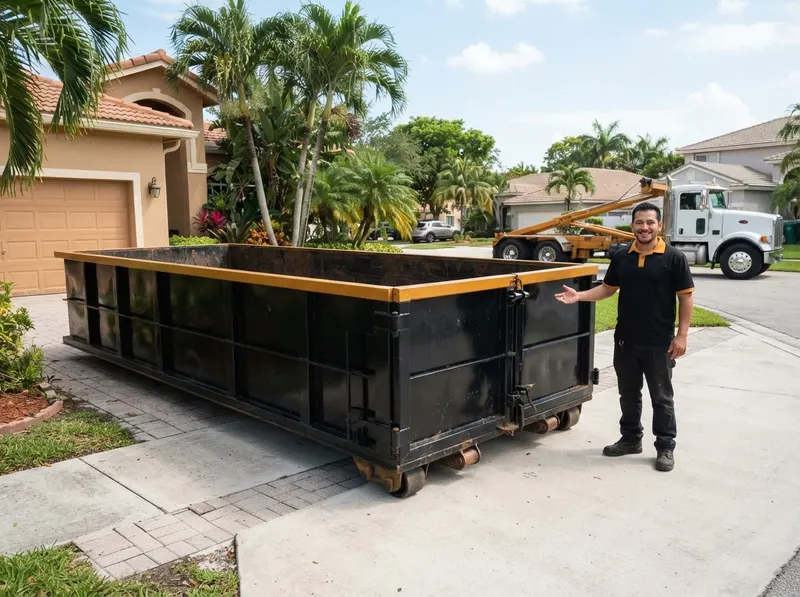
Managing continuous waste during major renovations requires proactive scheduling rather than reactive waiting. When a single roll-off container reaches its fill line, active job sites in dense neighborhoods like Brickell, Edgewater, and the Design District quickly stall out, risking municipal code violations or fines from residential homeowner associations. A scheduled swap-out sequence replaces a full roll-off container with an empty unit in a single visit, maintaining steady site momentum without staging piles on public rights-of-way. Driveway protection remains essential across South Florida properties, where high ambient heat softens asphalt and makes interlocking concrete pavers vulnerable to point-load fractures. Standard roll-off operations use heavy-duty hardwood dunnage boards under all steel rollers to distribute container mass evenly, adhering to jobsite surface safety measures aligned with OSHA jobsite standards.
Navigating local placement constraints requires strict coordination with municipal and county guidelines. The Miami-Dade County Solid Waste Management agency sets specific mandates regarding debris containment to keep streets clear during active tropical weather seasons. Homeowners working along narrow residential corridors in Coconut Grove, Little Havana, and Coral Way face strict spatial limits between boundary fences and mature canopy trees. ClearRock Disposal operates precision single-axle hook-lift and cable trucks designed to maneuver within restricted residential driveways near landmarks such as the Calle Ocho Walk of Fame and Vizcaya Museum and Gardens. If a project requires container staging on an active roadway rather than a private driveway, hauling teams align placements with clearance protocols established by the Florida Department of Transportation and local municipal public works departments.
Material handling rules mandate clean separation of general construction debris from regulated waste. Roll-off containers accept masonry, framing wood, mixed packaging, and interior demolition debris processed under guidance from the Florida Department of Environmental Protection. Paint cans, chemicals, and pressurized cylinders require separate disposal via municipal drop-offs, following safe handling frameworks defined by the US Environmental Protection Agency. For heavy masonry recycling, operators coordinate sorting procedures that reflect standards from the Construction and Demolition Recycling Association and national recycling practices outlined by Earth911. High-volume tear-outs follow guidelines from the National Association of Home Builders to maintain structural safety, while logistics routes comply with the Federal Motor Carrier Safety Administration and transport protocols overseen by the US Department of Transportation.
Every job gets a firm, written price after a free on-site visit.
For standards, safe disposal, and service guidance on DUMPSTER in Miami, FL, useful references include U.S. EPA, EPA, EPA, OSHA, Earth911, and Google Maps. General consumer and small-business resources are available from USA.gov, Better Business Bureau, FTC Consumer Advice, U.S. Small Business Administration, and Ready.gov.
Tell us about your same-day delivery & scheduled swap-out dumpster service job in Miami and we'll send a clear, written quote, usually the same day.
 ClearRock Disposal